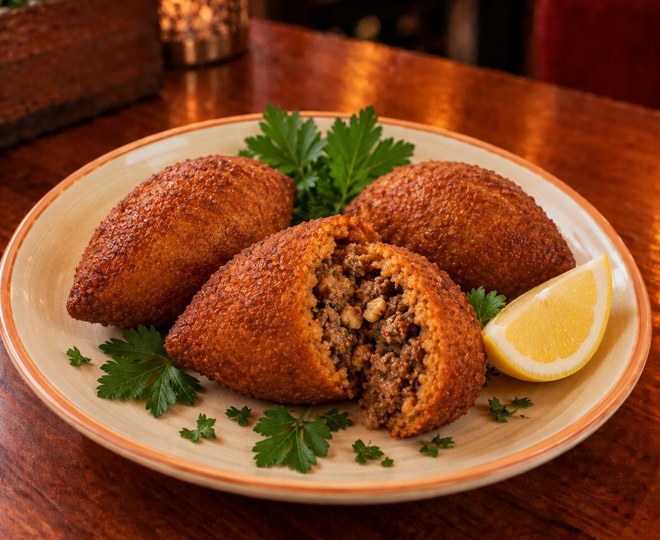
İçli köfte is a stuffed dish with a wheat-based shell surrounding a savoury filling. Unlike an ordinary meatball, it has two distinct parts rather than one mixture throughout. At Beyoğlu, the menu describes a wheat roll filled with seasoned minced lamb and ground walnuts.
You may recognise a related dish called kibbeh, kibbe or kubba. The resemblance is not accidental. İçli köfte belongs to a wider regional family of dishes made with grain and a savoury filling or meat mixture. Those names do not describe one identical preparation everywhere.
İçli köfte, kibbeh and kubba: a shared tradition
Kibbeh is a familiar name in Lebanese and Syrian cooking; kubba is a common name in Iraq. In Türkiye, this filled preparation is called içli köfte. Grain, meat and seasoning connect the dishes, while their shapes, shells and cooking methods can differ between places and households.
Not all kibbeh is a fried, stuffed oval. The family also includes preparations baked in a tray and boiled versions. Something that looks or sounds familiar may therefore give you a different texture from the içli köfte you have eaten before.
What do we know about the Ottoman period?
In his nineteenth-century book The Land and the Book, William M. Thomson describes wheat being pounded to make ‘kibby’ in Sidon. He mentions a fish version, then describes the more common mutton preparation being baked in a copper dish. This is a historical record of the food family, not an exact description of the fried version on our menu.
Kibbeh was therefore known in the Levant, the eastern Mediterranean region, during the Ottoman period. That does not establish that it was invented in an Ottoman palace or prepared uniformly across the empire. Today’s national borders tell only part of this culinary story.
A reconstruction of Armenian cooking from Urfa also records stuffed bulgur köfte, including a boiled preparation and meatless fillings for fasting days. The tradition extends beyond a single modern national cuisine. We cannot confidently identify one original maker or an exact date of invention.
What is the shell made from?
Many içli köfte recipes use fine bulgur for the outside. Bulgur is wheat that has been cooked, dried and broken into smaller pieces. It is not a separate grain or a type of flaky pastry. To form a shell, the bulgur becomes part of a mixture that can hold together around the filling.
In a preparation from Diyarbakır, a fine-bulgur mixture encloses a separately prepared lamb-and-onion filling. This is an example of a regional recipe, not a statement of Beyoğlu’s full recipe.
The shell-to-filling balance matters when you eat it. A bite taken mainly from an end emphasises the wheat; a bite through the centre brings the meat and seasoning into the same mouthful. Cutting one open is a useful introduction. It makes the structure clear before you taste it.
Why is some içli köfte boiled and some fried?
Different preparations also exist within Türkiye. One version from Bingöl includes walnuts and can be boiled or fried. The difference is therefore not just the name on a menu, but what happens to the shell during cooking.
The cooking method changes the outside in particular. A fried shell gives a different bite from the softer surface of a boiled version. Beyoğlu’s English menu describes a fried bulgur shell, so this is the fried preparation rather than the boiled one.
What do the lamb and walnuts contribute?
In Beyoğlu’s version, minced lamb provides the savoury centre, while walnuts contribute a nutty flavour. The menu specifies ground walnuts, so their role is within the filling rather than as a few large pieces scattered over the finished dish.
Seasoned does not necessarily mean intensely hot. The menu does not specify the spice blend or a heat level. If you prefer food without much chilli heat, ask about the preparation instead of trying to judge it from the Turkish name.
How is it different from köfte, börek or mantı?
Beyoğlu also lists ordinary köfte as seasoned lamb meatballs. With those, the meat mixture is the dish itself. With içli köfte, the meat becomes the centre of a wheat shell. Seeing köfte in both names should not lead you to expect two versions of the same grilled meatball.
The other filled dishes on the menu make different choices. Sigara böreği is described as pastry filled with feta and parsley. Mantı is listed as small dough parcels with minced lamb and yoghurt. For a first order, think about the part that appeals to you: lamb with walnuts inside a wheat shell, a cheese-filled pastry roll, or filled dough parcels served with yoghurt.
Trying içli köfte in Amsterdam Oost
You can find içli köfte among the warm snacks and starters at Beyoğlu, Eerste Oosterparkstraat 251B. It is an option to explore before a main course if you want to try something beyond the grill. Check Beyoğlu’s current menu for the description and price, and ask about the portion if you plan to share.